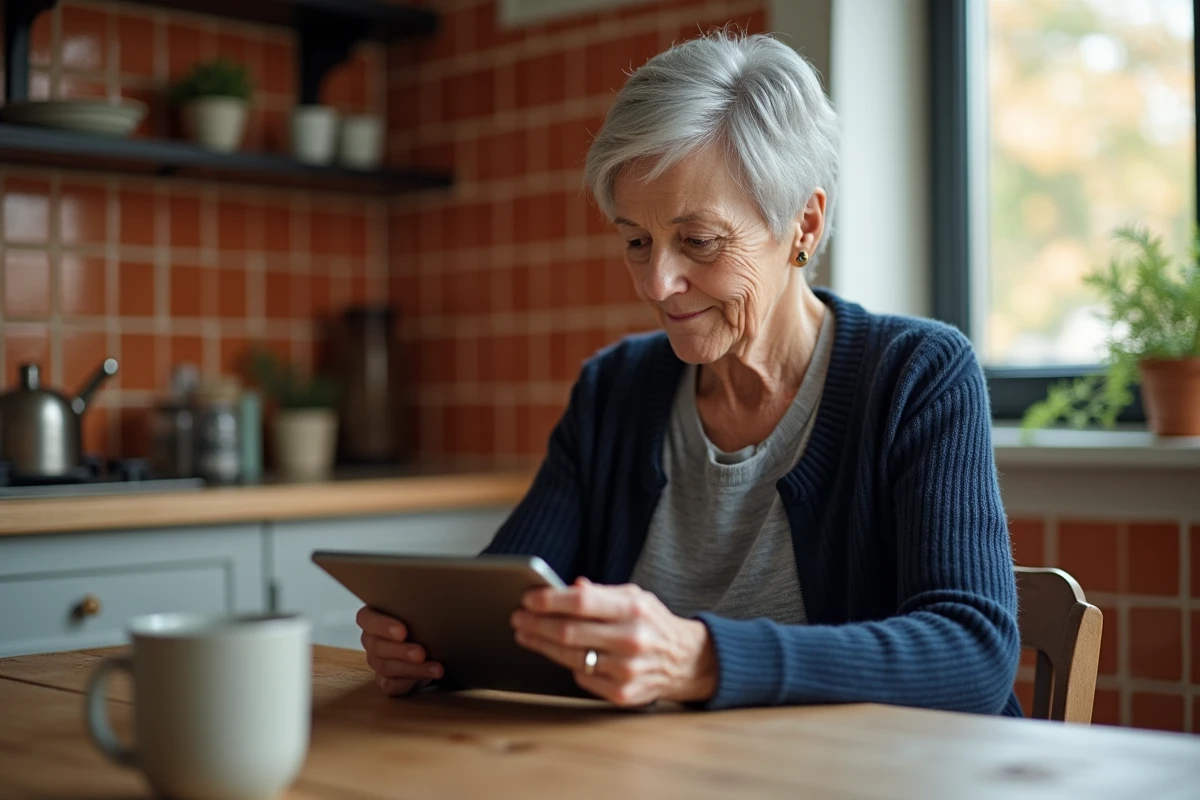
What digital services provide real assistance to seniors, and which ones remain underutilized due to a lack of appropriate support? This question deserves to be asked from the perspective of concrete usage rather than technological promises. Between health applications, teleassistance, social connection tools, and digital inclusion initiatives supported by local authorities, the offering is abundant. However, not all these digital services for seniors are equal in terms of adoption and daily effectiveness.
Comparison of Digital Service Categories for Seniors
Instead of listing applications one by one, grouping services by function allows for a better understanding of what meets a real need and what is merely a gadget.
| Service Category | Common Examples | Adoption Level by Seniors | Required Support |
|---|---|---|---|
| Teleassistance and Alerts | Alert bracelet, fall detector, SOS button | High | Low (intuitive use) |
| Teleconsultation and Health Monitoring | My health space, secure messaging, medication reminders | Increasing | Medium to high |
| Communication and Social Connection | WhatsApp, FaceTime, Famileo | Variable depending on the social circle | Medium |
| Online Administrative Procedures | Taxes, Ameli, CAF | Low among those over 75 | High |
| Cognitive Stimulation and Leisure | Memory games, radio, streaming music | Moderate | Low to medium |
This table reveals a clear gap. The simplest tools are also the most widely adopted, while high-value services (health, administrative procedures) are hindered by their complexity of use. A resource that lists and categorizes these services on Senior Surfers helps guide families toward solutions tailored to each individual’s profile.

Connected Health and Seniors: The Underutilized Lever
The field of digital health holds the greatest potential for improving the daily lives of elderly individuals. Medication reminder applications, teleconsultation platforms, and the My health space file form a coherent ecosystem, but their adoption remains uneven.
The Key Role of the Pharmacist in Digital Health Support
Experiments with “connected pharmacies” are developing in Île-de-France and Auvergne-Rhône-Alpes. The pharmacist plays a role as a digital facilitator: installing medication reminder applications, activating My health space, configuring telemonitoring devices. Initial feedback shows a decrease in medication forgetfulness and avoidable hospitalizations among those over 75 being monitored in these systems.
This model is interesting because it relies on a trusted professional whom seniors see regularly. Digital support builds on an existing relationship rather than creating a new point of contact.
Departmental Digital Health Passes
Since 2023-2024, several departments have been testing “digital health passes” aimed at those over 60, as part of the national digital health inclusion plan supported by ANS and DNS. These initiatives combine in-person workshops and individual support, with training focused on secure messaging and teleconsultation.
These passes are no longer limited to assistance with administrative procedures: they aim for digital autonomy in health, representing a notable shift in approach compared to the general computer workshops offered until now.
Equipment Without Support: Why It Doesn’t Work
Distributing tablets or simplified smartphones to elderly individuals is not enough. Several local authorities have recognized this, and since 2024, some have conditioned financial aid for equipment on a minimum number of hours of training or digital mediation for those over 70.
The initial observation is clear: the abandonment rate was high when devices were simply distributed without follow-up. A new device stored in a drawer after two weeks does not reduce isolation or the digital divide.
- Structured support (recurring workshops, identified referent) increases the duration of digital tool usage among seniors
- The connection with a local digital mediator, in town halls or libraries, allows for resolving issues as they arise rather than waiting for a breakdown to abandon the device
- The most effective training starts from a concrete need of the person (video calling a grandchild, making a medical appointment) rather than an abstract educational program

Teleassistance and Home Security: The Stable Foundation
Teleassistance remains the digital service most ingrained in the habits of elderly individuals living alone at home. The alert button worn as a bracelet or pendant works without any particular technical skill, which explains its wider adoption compared to other service categories.
Recent devices go beyond the simple SOS button. Motion sensors detect abnormal inactivity, and some systems integrate video surveillance with secure sharing to caregivers. Teleassistance requires no digital mastery, making it a natural entry point to other connected tools.
In contrast, complete home automation solutions (automated shutters, smart lighting, heating management) remain marginal among seniors due to their installation costs and complexity of setup. The gap between teleassistance and home automation clearly illustrates the rule that emerges from all the data: the adoption of a digital service by seniors depends less on its theoretical usefulness than on its ease of use.
The most reliable criterion for evaluating a digital service intended for elderly individuals is not the richness of its features, but the number of steps required to use it. The tools that work are those that can be activated with a single gesture, without a password, without updates, without a screen to unlock. As long as the design of digital services for seniors does not start from this constraint, the offering will remain abundant and usage limited.