French law has not been built on consensus. The 1881 law on press freedom, still in force, outlines the boundaries of caricature without ever stifling it. The removal of the offense against the head of state in 2013 did not close the chapter: prosecutions for insult or defamation still exist. In court, case law often leans towards satire, especially when it targets public officials: a matter of public interest, they say. But with each new media storm, the balance between biting humor and respect for the rules comes under scrutiny. Some take to the barricades to defend freedom of expression, while others call for more restraint. Each side stands firm, and the debate remains lively.
Caricature and satire, critical mirrors of French current affairs
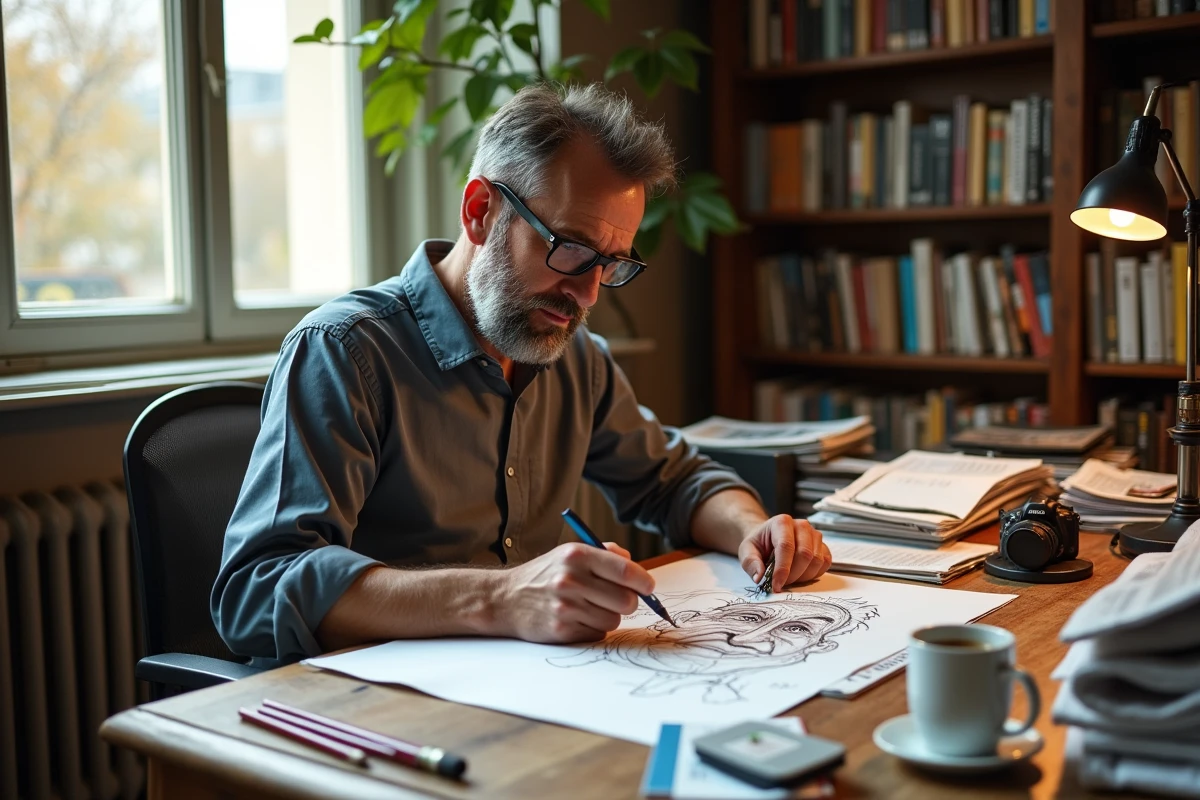
For generations, political caricature has made its way into the French arena. Heir to Charivari, the rebellious spirit of Hara Kiri, and press drawing, it does not merely decorate the margins of newspapers. It dissects power, attacks official discourse, and exposes the contradictions of society. Armed with irony, satire accompanies every jolt in the political landscape, oscillating between sharp commentary and democratic necessity. The cartoonists, never confined to a single role, claim this hybrid position at the intersection of journalism and art, halfway between chronicler and whistleblower.
The contours of their practice evolve with the currents of current affairs and debates. Provocation has long been the hallmark of titles like Hara Kiri or Charlie Hebdo. Now, it targets both major public figures and institutions, sparing no flaws in a sometimes faltering political system. The public, for its part, does not mistake it: it expects from press drawings this dose of subversion and a critical eye on French current affairs. On https://sarkostique.fr/, every week, creations humorously dissect political speech, continuing the tradition of satirical press.
The question of training and status remains: journalists for some, engaged artists for others. But all contribute to the metamorphosis of press drawing, which breaks codes, ventures without a safety net into sensitive topics, and serves as a relay for both the tensions and hopes of public debate. Caricature, far from being a mere illustration, today stands as a precious form of expression, both exposed and indispensable to the democratic debate in France.
Freedom of expression: how far can political humor go?
It is impossible to discuss satirical press in France without mentioning freedom of expression, this foundation constantly tested by successive crises. Caricature has defied censorship under Louis-Philippe and then under the Republic, continually testing the boundaries of the right to information and respect for individuals. The attack on Charlie Hebdo, the turmoil caused by the caricatures of the Prophet Muhammad: these episodes have left lasting scars, revealing the fault lines between provocation and social cohesion.
The cartoonist, caught in the nets of censorship and self-censorship, constantly confronts the shifting boundary between freedom of communication and the demands of ethics. For some, political humor becomes a weapon of resistance against political or religious pressures. For others, it is concerning when it approaches insult or defamation.
Here are the major issues surrounding political caricature:
- Press freedom must constantly navigate respect for sensitivities: each caricature forces a redefinition of the place of blasphemy, criticism of the state or government.
- The courts and the Council of State take on the role of arbiters, setting, on a case-by-case basis, the boundary between satire, defamation, and incitement to hatred.
France, skilled at handling paradoxes, often stands at a crossroads. On one side, the stubborn defense of satire; on the other, the desire to ensure national cohesion. Caricature continues to reveal the tensions of the present, from the debate on ethics to the demands for pluralism in the media space.

What real impact on society and public debate?
Caricature goes beyond mere mockery of the powerful. It shapes our collective view of politics and its actors. In France, political humor has carved out a unique place in public conversation, fueling analysis and questioning of dominant discourses. In just a few strokes, satirical drawings unmask postures and pretenses, expose propaganda, and challenge received ideas. They open a window onto truths that official speech struggles to reveal.
Satire plays the role of a catalyst in our democratic life: it questions power and encourages vigilance. The sometimes intense reactions to caricatures of Jacques Chirac or Nicolas Sarkozy illustrate this ability to engage the public in an active and critical reading of current affairs. Even when biting, laughter becomes a tool for political deciphering. At a time when the press is facing turbulence and polarization is increasing, caricature reminds us how necessary a vibrant political pluralism remains to resist uniform thinking.
Here is what we observe concretely:
- Society seizes these images, reinterprets them, and disseminates them widely.
- The public debate shifts, sometimes becoming tense, but never remains indifferent to their impact.
Ultimately, the line between provocation and engagement is gradually fading. Press drawing and caricature, true barometers of democratic vitality, continue to challenge, question, and prevent us from turning a blind eye. They remind us that in terms of political humor, France has not finished surprising or debating.